by Drew Martin
I saw Ex Machina in the movie theater today. It is the kind of well thought out, patient science fiction that I like. It references a lot of movies and there is a role that art plays in it that I want to mention even though one instance is quite obvious.
Caleb, an employee at an advanced search engine company, BlueBook, is invited by the founder/owner, Nathan, to put a fetching AI robot, Ava, through the Turing test - to see if she can pass for a human. While discussing consciousness they stand before a Jackson Pollock drip painting [I do not recognize it as a copy of his work and although I see it referred to as a "replica"...I think it was just whipped up for the movie without an attempt to approximate an actual work]. The painting is there to nod to the human nature of "automatic art" - "Not deliberate, not random. Someplace in between...to make art without thinking."
Ava spends her evenings at a simple desk in a small room drawing pictures. At first they are abstract geometries but then, after Caleb's request, she creates a picture of a glass-enclosed courtyard garden she can see, and then a portrait of him. These drawings are all triangulated and software driven.
The other, less obvious reference is to Gustav Klimt's painting of the sister of Ludwig Wittgenstein - one of the 20th century's greatest philosophers who covered logic, the philosophy of mathematics, the philosophy of mind, and the philosophy of language. He is referenced several times in the film. Klimt's painting of his sister represents Ava's human side. Towards the end of the film, Ava walks by it wearing a white dress.
To promote the film an Ava "session" website was set up, on which Ava asks you (typing) if she can draw a picture of you. If you say yes, your laptop camera turns on, snaps your picture, and then a triangulated image of you is worked out. Pictured here, bottom, is my portrait drawn by Ava. Check it out at http://ava-sessions.com.
Monday, April 27, 2015
Sunday, April 26, 2015
Searching for Marissa Mayer
by Drew Martin
If you are artistic and creative, and would not touch an MBA-type with a ten-foot-pole but still want to get some insight on the business world, then I would recommend picking up a copy of Fast Company. It has a personal side to the people who get ideas rolling into working businesses. On the cover of the May 2015 issue is a flawless picture of Marissa Mayer, the computer engineer who became the 20th employee at Google, and who is now the CEO of Yahoo!
Yahoo! won me over back in the day with their "quilting" commercial. In it a punk rocker is having some alone time in his band's practice room. We see him peacefully quilting until his three other band members walk in on him and start hysterically laughing. The next scene we see him searching "clubs" on Yahoo! and a moment later we see him on the porch of a southern mansion, quilting with fawning southern belles. As a guy who sews, it hit home, and it also captured what new communities the world wide web was forming at that time.
Yahoo! was good but then Google came along and buried it. I still have and use my original Yahoo! email address. I have two actually. I also have a couple Gmail accounts but I use my Yahoo! more for some reason.
So I have seen Yahoo! rise and fall, rise and fall. A lot of people have liked kicking it when its down, and predict its ultimate demise with or without Mayer on board. To sum up the Fast Company article, Mayer has done a stellar job, and the company has been catching up. Through their push for native apps, they have created a few nice to have but not need to have products.
I had never heard Mayer speak so I decided to do some catch-up myself. First I watched her keynote speech at the 2014 International Consumer Electronics Show in Las Vegas. It was awkward, stiff and most things fell flat. But then I followed that with a video posted in 2006 of her speaking to a small group at Stanford, her Alma Mater, and it was fascinating. She is a clear, articulate, and intelligent speaker. Her Finnish (mom's side) pixie features are contrasted by a wacky laugh and a raspy voice that sometimes approaches Marge Simpson. Then I watched a 2012 interview with her by NPR correspondent Laura Sydell. In it she is just as fascinating to watch. When you hear her speak you know she got to where she is through her intellect, and hard work. Although she started out at Stanford to become a pediatric neurosurgeon, she ended up getting a BS, and then an MS in computer science for artificial intelligence by focusing on symbolic systems.
Mayer is a minimal sleeper and says shes used to pull an all-nighter once a week when she worked at Google. I appreciate her ability to keep a focused conversation on track. Multiple times Sydell tries to get her to speak about her female experience, and women in coding, but Mayer doesn't grant that angle. Instead, she talks about the need to have more coders and diversity in general, and talks about being gender blind. Likewise, she prefers the "clause" be dropped when others speak about her own achievements.
When asked about burnout, Mayer offers that she thinks burnout is really more about resentment, and she would rather focus on rhythm than work-life balance, and gives a few examples from her experiences where she had to deal with this issue as a manager.
Despite being turned off by the CES Vegas speech, I looked into a couple of the apps discussed and installed some of them on my phone. Yahoo! Weather is quite brilliant actually because it pulls from their acquired Flickr database to serve up locally relevant images for the city locations, and gives credit to the photographer. Their reasoning is obvious; so you can take a look at recent images from that location, but I think people use weather searches for more social reasons, such as getting a bit closer to someone in a far away location. I have done this even when the weather report was just the high and low numbers. With the images of that place, it makes it that much more intimate.
The other app I downloaded is Yahoo! News Digest. It is a really slick and cool approach to serving up news. It shows seven or more stories, with additional reads and sources tucked nicely into the design. When you finish with the string of stories, a completion dial satisfyingly fills up and you are left with a takeaway quote. The stories are loaded/refreshed every morning and evening. I just went through tonight's articles and was left with the following quote from the photographer Diane Arbus, "Taking pictures is savoring life intensely every hundredth of a second."
While some people struggle to make connections between art and science, Mayer embraces the synthesis. Her mother is an art teacher and her father is an engineer. She sees her career as a continuing combination of those two fields, and encourages the serendipitous collision of ideas to create what she calls the Reese's Peanut Butter Cup Effect. After spending some virtual time finding out more about Mayer I second the Fast Company heading Don't Count Yahoo Out - How CEO Marissa Mayer Will Defy Her Critics.
Thursday, April 23, 2015
Walk-In Pantry by Summer Wheat
by Drew Martin
The Fridman Gallery is a smart little gallery in SoHo that has big ideas. I like this space because each of the four shows I have seen there in the past year was entirely different: artists, medium, lighting, floor plan and mood. I imagine it as a museum with each show, flowing into the other. The gallery is close to my work so I stopped by at lunchtime today to catch the current show before it closes on Saturday.
This solo exhibition, Walk-in Pantry, by the artist Summer Wheat, immerses the viewer in an installation of paintings and paint-rugs that reference the surroundings of Vermeer's The Milkmaid.
I first felt a little oppressed in front of Wheat's paintings because they are heavy with black charcoal mixed with the paints but then they open up to you. It is actually a really odd sensation; you first feel the presence of basic shapes, but then you see something more definite about them. They have an immediate impression like a Motherwell, but then you see objects in the forms and there is a kind of clarity you feel...like I did not understand this ten seconds ago but now I do. In many ways this sums up art.
Wheat's most powerful works are her paint-rugs. I love when I see an artist own a technique. In this case it's the way she pushes acrylics through a fine plastic mesh, and then decorates them.
Wednesday, April 22, 2015
Going Solo in SoHo
by Drew Martin
When I was a kid SoHo was Bohemian turf. The museums were uptown, but SoHo was flush with galleries, artists studios, and supply stores. As all of that got priced out and the artists were overrun by European tourists on trendy shopping sprees, the galleries moved up to Chelsea. There was talk of that all moving over to the Bowery to litter around the New Museum but the High Line took off and The Whitney Museum of American Art relocated there, so it seems like Chelsea will hold onto to its art scene. One of the most respected art institutions in SoHo, The Drawing Center, had plans to relocate to Ground Zero after 9/11 but that fell through, as did another location they had there eye on, the South Street Seaport. Instead, they stay put, renovated their space and continued to focus on curating great shows.
Gone are all the great fabrics stores and other raw material suppliers. Likewise, Canal Plastics and Pearl Paint fairly recently closed shop. But SoHo Art Materials relocated to Wooster Street, just below The Drawing Center. I needed some art supplies, and I like this store a lot so I walked down there today to buy some paint, pens, and drawing paper. I stopped by The Drawing Center on the way there and walked through a nice portrait show from École nationale supérieure des Beaux-Arts in Paris, which explores 400 years of portrait drawings.
I did not care too much for the work they had going on in the back room for The Brothers Grimm show by Natalie Frank, who made a series of colorful but heavy gouache and chalk pastel drawings that deal with the tales. But I did like the small drawings by the U.K. artist Rachel Goodyear, which are squeezed into the narrow basement space: The Lab Corridor.
The biggest art surprise today, however, came after The Drawing Center, and after SoHo Art Materials. I left the store and passed the former Deitch Projects Gallery, which is now the Swiss Institute. Their space lured me in because it looked interesting and joyful. The show, Work Hard, is a quirky collection of contemporary art as well as drawings from Marguerite Burnat-Provins, a writer born in 1872. The first thing you notice is Black Balthazar by Mai-Thu Perret, a rattan core sculpture of a donkey - Balthazar from the 1966 classic French film Au hasard Balthazar.
Each piece in the gallery is quite different from the other, as this is a group show of two dozen artists. On a wall near Balthazar, is a wonderful kinetic metal mobile relief by Jean Tinguely from 1959. In the next room a life size female sculpture wears a gorilla suit [Alma (After Kokoschka) by Denis Savary]. On the opposite wall is a rocky landscape with two boots, one of which has stepped into a rat trap [Le danger de la multiplication by Daniel Spoerri].
My favorite piece from my quick spin of the gallery was Skin by Latifa Echakhch. It's just a cluster of 13 pairs of shoes but it reminded me of my time living in the Czech Republic, where everyone took off his or her shoes before entering someone's apartment. So this mass of shoes made me feel like a bunch of young people where on the other side of the wall having a good time. It also does something that a lot of artwork strives to achieve, which is to have a very different look and experience from another angle. The gallery is such that you can actually look down on top of this collection of sneakers so while the first approach is sculptural, the second pass from above has more of a painterly or photographic experience.
Sunday, April 19, 2015
3D Print People Are Such Exhibitionists
by Drew Martin
I went to the Inside 3D Printing show at the Javits Center on Thursday. It was smaller than what I imagined and not as exciting as I had hoped. The show had a manufacturers space and a designers section. The manufacturers space was what you would expect - small booths with 3D printers, spools of filament and 3D prints. The booth that got the most attention on that side was Artec 3D's full body scanner, with a line of people waiting to get scanned. Even though I had seen this technology before, it was still interesting to see again. It is remarkable that you can get a realistic, and extremely detailed 3D print of yourself or someone you know. The first time I saw this, I imagined a home's mantel with a line of ancestral statues. I spoke with Moscovite Anna Galdina, pictured here with a 3D print of herself in her hand. She said they developed the technology in Russia but the country's business laws were too prohibitive to make it work so they picked up and moved to Palo Alto, California and have prospered ever since.
The design half of the show was also what one might expect - a hodgepodge of toys, fashion accessories, jewelry and other chotchkies, some white architectural models, and a few manufacturing design products. The oasis of this section was Ashley Zelinskie's 3D-printed Brillo box placed in an infinity room, lined with mirrors. While the Brillo box reference's Andy Warhol's recreation of the actual product with his silk-screening technique, Zelinskie adds a twist by creating a lattice-work using the hexadecimal code behind the file for the work. I like the nod to Warhol and the idea of a 3D file being infinitely reproducible, but the use of code as a physical structure is more interesting, and is fortunately behind much of Zelinskie's work.
If you visit Zelinskie's website (www.ashleyzelinskie.com) you will see an even more fitting, and one could say - digitally philosophical nod, to Joseph Kosuth’s One and Three Chair.
The hexadecimal sculpture is a recreation of Joseph Kosuth’s “One and Three Chair” piece. Kosuth poses a question of the reality of the chair in his sculpture. I chose to recreate this idea using one object. A 3D rendering of the chair used in Kosuth’s project was created, broken down in to its basic hexadecimal code, and its skeleton build back up using only the code. The chair will look like a chair to both human and computer and will pose the question “which is the real chair?"
Watch the Tech Times interview with Zelinskie below:
I went to the Inside 3D Printing show at the Javits Center on Thursday. It was smaller than what I imagined and not as exciting as I had hoped. The show had a manufacturers space and a designers section. The manufacturers space was what you would expect - small booths with 3D printers, spools of filament and 3D prints. The booth that got the most attention on that side was Artec 3D's full body scanner, with a line of people waiting to get scanned. Even though I had seen this technology before, it was still interesting to see again. It is remarkable that you can get a realistic, and extremely detailed 3D print of yourself or someone you know. The first time I saw this, I imagined a home's mantel with a line of ancestral statues. I spoke with Moscovite Anna Galdina, pictured here with a 3D print of herself in her hand. She said they developed the technology in Russia but the country's business laws were too prohibitive to make it work so they picked up and moved to Palo Alto, California and have prospered ever since.
The design half of the show was also what one might expect - a hodgepodge of toys, fashion accessories, jewelry and other chotchkies, some white architectural models, and a few manufacturing design products. The oasis of this section was Ashley Zelinskie's 3D-printed Brillo box placed in an infinity room, lined with mirrors. While the Brillo box reference's Andy Warhol's recreation of the actual product with his silk-screening technique, Zelinskie adds a twist by creating a lattice-work using the hexadecimal code behind the file for the work. I like the nod to Warhol and the idea of a 3D file being infinitely reproducible, but the use of code as a physical structure is more interesting, and is fortunately behind much of Zelinskie's work.
If you visit Zelinskie's website (www.ashleyzelinskie.com) you will see an even more fitting, and one could say - digitally philosophical nod, to Joseph Kosuth’s One and Three Chair.
Watch the Tech Times interview with Zelinskie below:
Saturday, April 18, 2015
Which Do You Want to Hear First...the Good Muse or the Bad Muse? (Let's Start With the Bad Muse)
by Drew Martin
One thing I can be sure of when I do back-to-back gallery visits to Gavin Brown's Enterprise and the Maccarone gallery is that GBE will always have big, tacky work, and the Maccarone gallery inevitably will have something more interesting to spend time with. Everything I have ever seen at GBE has an immediate sensation, that leaves me cold in a matter of seconds. And Maccarone always helps redeem contemporary art with a little more craft and thought. This is why I always visit GBE right before Maccarone. Last week my take on GBE's show Here's Good Looking @U, Kid by Karl Holmqvist with an addendum by Rirkrit Tiravanija, followed by Maccarone's 17-person group show All Back in the Skull Together was no different. I did actually like Holmqvist's "untitled" Four letter word sculptures (FUCK, LUVV, PUNK, and LIKE) and I also like a printed piece but the paintings fall into the GBE trap of feeling like the artist is just trying to cover the walls.
What I liked the most were a couple simpler sculptures such as Jo Nigoghossian's Hole With Some Bars, and Sarah Lucas' Mammerylooloo whose use of the toilet and the soft sculpture nylon stocking breasts simultaneously evokes Duchamp and Oldenburg.
And I especially liked Sam Anderson's floor-level and tiny sculptures Texas, and France, which have leather scrap territories.
I was not familiar with Eva Kotátková and found this interview with her when I looked her up:
Tuesday, April 14, 2015
In Memoriam: Shannon Eckhart
by Drew Martin
It's nearly midnight and I am up 3D printing tuxedo studs (right black squares in top image) because I have a black tie event for work in two nights in New York. I am fudging a real tux with a black suit and tuxedo shirt. I have a bow tie and cuff links but I do not have studs so I modeled them earlier in Google SketchUp, made some adjustments, and now I am sending them to print on my home 3D printer.
I do not go to these kinds of events often. In fact, the last one I went to was two years ago in Washington, D.C., which was the last time I saw a former colleague and friend named Shannon Eckhart. A couple weeks ago, at the age of 37 she died from a blood clot that she developed while flying on a business trip.
At the D.C. event I had the same outfit but at that time I thought my shirt had white/clear backup buttons. It did not; only stud holes. I noticed this minutes before the event and panicked. I took an old, spare black sock, cut it into strips and knotted the ends (pictured left in top image) and then I worked them through the holes so that one strip would take care of two places. It was an ingenious and desperate solution.
Once I got to the event someone immediately commented on my artsy DIY studs and I told this person they were made out of yak hair from Tibet. Then I bumped into Shannon, who I was not expecting to see because she was already working for another company. I explained to her my wardrobe malfunction and she cracked up and spent the rest of the evening retelling the story to people we bumped into.
Shannon was high energy, full of life, and always fascinated by the arts and especially artists. Sometimes I become reclusive and take a step back from everything for a while but I need to remember how she pulled the creativity out of people because of her thirst for it. So I want to take the remainder of this post to talk about a couple things in the recent past that I have not written about, which I know she would like to hear about. One event was a talk that a Polish friend and I gave at the Polish school where my wife teaches on Saturday mornings. We spoke in Polish to a couple classes of kids about our artwork. You can see me here (second from top) signing my cartoon books for the young attendees.
The other recent thing is that I went with my two older, teenage kids on a trip to California to visit friends and family. I had planned to make videos of my friend artists: Anne Hars, Bill Wheelock, Rebecca Scalf, Bob Stang, and Kirk Maxson but when I got out there I did not feel like bothering them and putting them on the spot; it would have felt forced. Instead, I enjoyed looking at their work, hearing them speak about it without needing to record it, and appreciating the beauty of the California landscape, the surfers, redwood forests, and this special time with my kids.
I did take one picture of the Chumash Indian cave paintings in Santa Barbara (second from bottom), as well as a couple pictures from Kirk Maxson's studio in San Francisco (bottom). My 3D prints are continuing to fail tonight because my printer does not handle tiny prints very well. I think I will go with the knotted sock strips again in memory of Shannon.
Saturday, March 28, 2015
Levitated Mass: The Story of Michael Heizer's Monolithic Sculpture
by Drew Martin
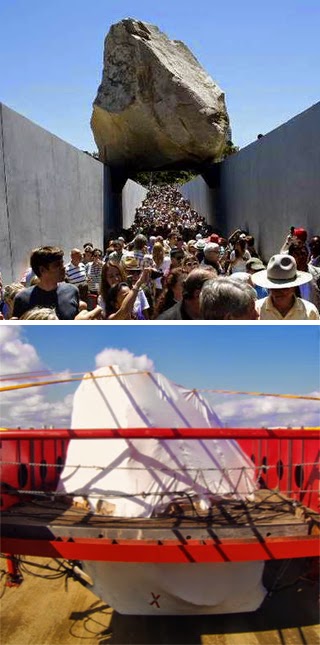
It is not every day you come across an hour and a half long film about one sculpture so I recently relished watching Levitated Mass: The Story of Michael Heizer's Monolithic Sculpture.
Heizer received formal lessons at the San Francisco Art Institute in the early 1960's but the paintings he produced became more about sculpture and his sculptures became more about the world beyond the walls of galleries and museums. Heizer brought heavy construction to art with big earth-moving machines. A few of his pieces are about negative space, such as Double Negative, which he made in 1969 by carving out two swaths of sandstone rock about the size of the Empire State Building (on its side).
Levitated Mass is an enormous quarried rock that now sits on a trench outside of LACMA (Los Angeles County Museum of Art). The documentary is of course about the installed piece and Heizer's vision but the movie celebrates the engineering behind the logistics of transporting something so big and setting it in its place.
For much of the documentary we follow the moving crew as they hauled the rock with a specially designed rig, which was the size of a football field so that the load could be distributed over a large area; essential for when it was driven on overpasses.
The travel distance from the quarry to LACMA was more than 100 miles, and many of the crew walked along side the rock. The best part of the documentary were the candid interviews with the locals who came out to watch the procession. One man even used the occasion to propose to his girlfriend. And everyone had something different to say: from religious references and epiphanies to disbelief and suspicion. One woman even thought that it was military secret and offered that the form might just be styrofoam that encased some device.
What I liked learning the most about was that Heizer's father was an anthropological geologist, which means he was interested in stonecarving cultures, such as the Olmec, who had to move heavy blocks of stove over large distances.
Monday, March 23, 2015
Life Itself: A Documentary About Robert Ebert, The Soldier of Cinema
by Drew Martin
Looking back at everything I watched as a kid on television, one of the show's I liked the most was Gene Siskel and Robert Ebert's At The Movies. It brought to television an argumentative conversation about the pop culture of movies by two frenemies from Illinois who were movie critics at competing Chicago newspapers. I loved how they locked horns but I always appreciated more Ebert's insight and intellect so I was delighted to see there is a documentary about him on Netflix called Life Itself. It is an very intimate look at Ebert's life (1942 - 2013), from his struggles with alcohol to his medical issues including the removal of his jaw because of cancer. Werner Herzog, who dedicated his film about Antarctica, Encounters at the End of the World to Ebert, called him the soldier of cinema because of his perseverance and steel will.
The documentary opens with a speech Ebert gave in 2005:
We all are born with a certain package; we are who we are - where we were born, who we were born as, how we were raised. We are kind of stuck inside that person. And the purpose of civilization and growth is to be able to reach out and empathize a little bit with other people. And for me the movies are like a machine that generates empathy. It lets you understand a little more about different hopes, aspirations, dreams, and fears. It helps us to identify with the people who are sharing this journey with us.
This occasion for this speech was for his star dedication: he was the first film critic to receive a star on the Hollywood Walk of Fame, and 30 years earlier he was the first film critic to receive a Pulitzer Prize. The ubiquitous "thumbs up" image in social media is a direct descendant of this simple rating system introduced to television by his show. Ebert was certainly ahead of his time (and the Twitter phenomenon): he introduced the idea of direct reporting from Cannes about the movies being shown during the film festival, in a time when the rest of the critics took notes during the events, and then wrote about the movies they reviewed after they returned home to their respective media outlets.
The aforementioned speech is followed by a text quote from him that is centered on the screen:
"I was born inside the movie of my life...I don't remember how I got into the movie, but it continues to entertain me."
If his own life was a movie, then the best supporting actor goes not to Siskel but his lovely wife Chaz, who we see a lot of in this documentary. Ebert was an active blogger and his blog can still be seen at www.rogerebert.com, which includes a blog by Chaz.
Tuesday, March 17, 2015
Rich Hill
by Drew MartinI watch, read, and see a lot of things that I do not write posts about, despite what you might think based on the contents of this blog. There was one documentary, Rich Hill, I recently watched that I really liked, and liking it was enough for me so I did not feel like I should work it into a post. But tonight my daughter asked me why I watched it, and why I liked it.
Rich Hill is a fly-on-the-wall documentary that was made by two cousins who turned their lens on the small town Missouri life that they know firsthand. It follows three teenage boys, Andrew, Appachey, and Harley. All three are disadvantaged, some would say white-trash kids, but despite being uneducated and rough around the edges, they are all very likable in their own, unique way.
I like this film a lot because there is no agenda, other than and honest "walk a mile in my shoes" approach. And, most fortunately there is no character/subject gentrification. It is not a film about escaping an impoverished life through talent or luck but rather, take each day as it comes, and hopefully the next one is better.
There were two art-related moments that took me by surprise and they were both in the presence of Appachey, the most reckless of the youths. With no apparent focus or direction in life, he says out-of-the-blue that he would like to be an art teacher in China. He then continues to say that if you are an art teacher in China, all you have to do is sit around and draw pictures of dragons all day. From an adult that would be an off-color remark but from a young boy, it is a dream job/world.
The other "art" moment is when Appachey is walking around a run-down section of town by an highway underpass. He complains there is ice everywhere and apparently wants to smash it all. He walks through one huge puddle that has a thin layer of ice, and throws rocks and even his skateboard at it to break it, which seems delinquent and pointless but then he steps back and holds out his arms and exclaims, "The amazing splatter art." It is a scene that explains how unlikely artists such as Julian Schnabel and Damien Hirst got their start.
Tuesday, March 10, 2015
Web Junkie: In the Real World Everybody is Fake
by Drew Martin
A distraught Chinese teenager who has been locked up in a military hospital for a boot camp-style rehab program is asked why he is there. He sobs, "I used the Internet."
Web Junkie is an eye-opening documentary about one of China's (roughly) 400 rehab centers that have been established to make certain youth go cold turkey on "electronic heroin." The term is used when describing the addiction to (primarily) online video games. [The expression in Chinese for computer is electronic brain]
While the prison-like atmosphere seems extreme, especially the ten-day solitary confinement used to punish a boy featured in the documentary who escaped and then was returned, the young junkies pushed their desperate parents over the edge by skipping school, spending nights and days in the arcade/call center-like internet cafés, and losing touch with reality. One of the youths in the center brags about playing Warcraft for 300 continuous hours, pausing briefly to take cat naps. Some kids even wear diapers made for incontinent adults because they worry that taking a bathroom break will affect their performance. A father of one of the rehab kids claims his colleague's son died in one of the cafés at night.
The boys are typically tricked into the stay, which is a minimum four months. One of the boys says his parents told him they were taking him for a ski trip to Russia. Some kids are even drugged in their sleep by their parents. The parents, however, often seem to be the root of the problem. They are demanding about their schoolwork and not loving. One father explains that he beats his son, and wants the people running the center to do the same. He adds that he once tried to stab his son with a knife.
The Chinese government classifies Internet addiction as a clinical disorder and reports to have more than 20 million Internet addicts. One of the adults in the documentary muses that this is related to their one-child policy, and most of the kids in the program question the reality of their life in China compared to the fantastical world of their video games.
Sunday, March 8, 2015
A Taste of Civilization
by Drew Martin
If you have been to the Metropolitan Museum of Art in New York City and visited the 40,000-square-foot wing on the south side that houses the arts of Africa, (native) Americas, and Oceania, you might have noticed it is dedicated to Michael C. Rockefeller. The collection was kickstarted by Michael’s father, Nelson A. Rockefeller, a former governor of New York, who donated his more than 3,000-piece collection to the Met. Many of the objects in the collection were gathered by Michael during his anthropological and art collecting trips in New Guinea. He was most fascinated by the Asmat people and their ancestral bisj poles (pictured top), which embodied cycles of life and the cannibalistic headhunting raids.
The completion of a bisj pole usually unleashed a new round of raids; revenge was taken and balance restored, new heads obtained—new seeds to nourish the growth of boys into men—and the blood of the victims rubbed into the pole. The spirit in the pole was made complete. The villagers then engaged in sex, and the poles were left to rot in the sago fields, fertilizing the sago and completing the cycle. smithsonian.com
On November 18, 1961 Michael was aboard a makeshift boat during a return expedition in the region. The boat capsized in the rough delta of the Pulau River/Eilandenrivier of the Arafura Sea. Michael left a Dutch companion with the debilitated craft and tried to make the more-than-three-mile swim to shore, which was done successfully earlier by two locals who had also been aboard. He was never seen from again.
Michael was thought to have drowned, or to have been eaten by sharks or crocodiles. There was also strong evidence that he reached shore but was then murdered by Ajam, (pictured here, middle, in a photo from 1973 when he was chief of the Dani tribe) who acknowledged killing Michael and, with the help of others, eating him.
Cannibalism was revenge based so Michael and other Western visitors to this region were typically outside of that death cycle but the tribe that is said to have killed him had yet to revenge deaths by a Dutch official who shot and killed Asmat people a few years prior. One other fantastical story is that he shed his past, and cultural trappings, and went native. Film footage from 1969 of an Asmat war canoe fleet fueled this speculation when a Caucasian man who resembled Michael was noticed among the cannibals. (Still from footage pictured below)
While the latter story is the least likely because of the extensive search for him, it does make for an interesting tale, especially since Michael hastily returned to the area after a brief visit to New York, where he learned his parents were getting divorced. And who better to turn his back on Western culture than one of the heirs of the greatest fortunes, compounded by an unsettled feeling he must have had for his trading of Western tools in exchange for a kind of cultural robbery of a people he had grown so close to, who he found uninhibited and unburdened by the problems of "civilization." And while it is hard to find a good angle at the butchering and consumption of a fellow being, the Asmat people believed you took on the knowledge and power of the individual you cannibalized.
What recently piqued my interest in this topic was a documentary I watched about the search for Michael:
To see a more recent incident of cannibalism in Western culture, watch Ke$ha's video, Cannibal:
Sunday, March 1, 2015
Whiplash: Perfect Timing
by Drew Martin
Last night I saw the brilliant film Whiplash about the demanding atmosphere of jazz musician students at the Shaffer Conservatory, a fictitious stand-in for The Juilliard School in New York City. It focuses on a jazz drummer (played by Miles Teller) and the all-consuming life of trying to achieve and then hold on to the coveted position as core drummer in the elite studio band, which is conducted by a drill sergeant of a teacher (an amazing performance by J. K. Simmons). The film is, of course, about jazz, and drumming, but it is really about the drive for perfection and the caustic and abusive relationships that are sometimes needed to achieve great things.
Saturday, February 28, 2015
Norwegian Would: Twin Sisters and F*ck For Forest
by Drew Martin
Perhaps I am just tuned in to this because of a long, record-cold winter in the Northeast but there seems to be a lot of Norway going around. I recently overheard my Skyping sister-in-law in Poland say that she would like to move her small family to Norway because of a film she watched. It compares the lives of twin Chinese sisters who were found in a cardboard box. The discarded babies were separated and independently handed off to a family from Fresvik, Norway, and a family from Sacramento, California. The families made the connection on their own and make efforts to keep the adopted girls close despite the great distance and language barrier between them.
The hour-long documentary about these girls, Twin Sisters (Tvillingsøstrene), is a Norwegian film by Mona Friis Bertheussen so it is a little over the top with glorious music every time there are fjordic nature scenes. The Fresvik shots are undeniably beautiful but the poor life in a bleak village with only one store and a small, mediocre school is over-romanticized, and Bertheussen tries her best to show the worst of America in a fake-nice way. There is no mention, for example, how close the "trapped in suburbia" American twin lives next to some of the most majestic forests in the world. I also had to laugh when the American twin is directed to look out over the Pacific Ocean as if to look out for her sister. First of all, the ocean is farther from Sacramento than the nearest forest, although it is passed off as a feature of her city and secondly, the distance to Fresvik from that spot over the Pacific is more than 13,000 miles. If she turned around it would only be 5,000 miles.
Click here to watch the entire documentary
The other Norwegian influenced film I saw recently was F*ck For Forest (FFF). Quite the contrast to the picturesque Rockwellian documentary mentioned above, FFF is a feature-length documentary about a couple Norwegians who started the FFF not-for-profit, eco-porn organization, which raises money to protect the world's endangered forest through the creation and dissemination of amateur porn (primarily through the FFF website). This business model is fueled by asking people they meet at parties and walking around Tiergarten in Berlin to pose naked or have sex for them, and charging the voyeurs who want to watch it online.
FFF is a narrative-driven documentary made by the Polish director Michał Marczak. It got a lowly, sub-two-star rating on Netflix, but it is actually a five-star work of art. It captures this delusional motley crew's rawest moments from their reestablished base in Berlin, Germany to a flop of a trip to South America, which falls apart when they are shouted out of a town gathering where they had hoped to be embraced by as great benefactors. FFF brilliantly captures the subculture of Europe that not a lot of people get to experience, but which Marczak gives us a first-hand and unbiased look. It might be a hard film to watch for some people but I trust it much more than Tvillingsøstrene.
And what a great trailer!
Subscribe to:
Posts (Atom)